Another milestone for women in racing: Imamura wins Japanese Oaks
May 30, 2026
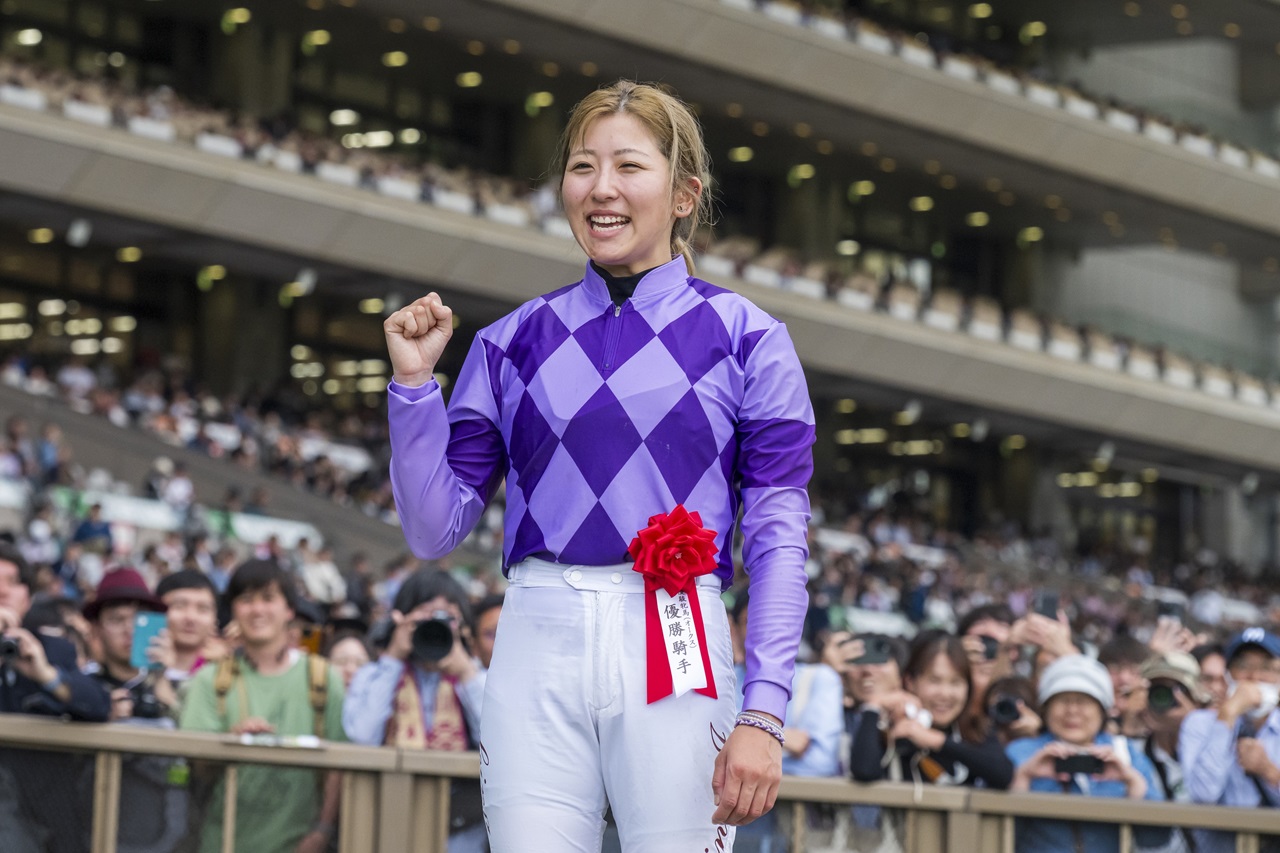
Seina Imamura became the first female jockey to win a Japanese classic (Photo by Tomoya Moriuchi/Horsephotos.com)
About three weeks after Cherie DeVaux made history as the first woman to train a Kentucky Derby (G1) winner in Golden Tempo, Seina Imamura scored a breakthrough as the first female jockey to win a classic race in Japan.
Imamura’s historic achievement came in the May 24 Yushun Himba (G1), the “Japanese Oaks” at Tokyo, where she steered Juryoku Pierrot to a thrilling come-from-behind victory by a neck. Watch her in the white blinkers, pink cap, as she advances from far back, through the midst of the field, and splits rivals late:
【🇯🇵 Yushun Himba (Japanese Oaks) (G1), Tokyo, 2400m, 3yo F, approx US$ 2.08m】
Winner: Juryoku Pierrot(JPN)
J: Seina Imamura
T: Ryo Terashima
Sire: Orfevre
Dam: Happy Value#優駿牝馬( #オークス ) は、#ジュウリョクピエロ が優勝!! pic.twitter.com/WvzhHAWANI— JRA World Racing (@JRA_WorldRacing) May 24, 2026
The Yushun Himba is dubbed the Japanese Oaks because its conditions resemble the original Oaks (G1) at Epsom. Both are prestigious races for three-year-old fillies held at about 1 1/2 miles on turf.
Our Kentucky Oaks (G1), although contested on dirt, was similarly inspired by the Epsom Oaks – just as the Kentucky Derby echoed the Epsom Derby (G1). Indeed, both the Kentucky Derby and Oaks began as 1 1/2-mile affairs in 1875 to match their English prototypes. The Kentucky Derby was trimmed to 1 1/4 miles in 1896. The Oaks was also shortened, ultimately settling at 1 1/8 miles.
Only one female jockey has won the Kentucky Oaks, Rosie Napravnik, and she did it twice. Napravnik’s trailblazing victory came in the 2012 Oaks aboard the 13.80-1 shot Believe You Can. Two years later, she scored on even-money favorite Untapable, who concluded her championship campaign in the 2014 Breeders’ Cup Distaff (G1).
Imamura’s landmark win in the Japanese Oaks came as something of an upset. Her mount, Juryoku Pierrot, went off as a 9.90-1 chance in an 18-filly field.
By the great Sunday Silence-line champion Orfevre, who swept Japan’s Triple Crown on turf in 2011, Juryoku Pierrot started her career on dirt. She won her debut, but failed to progress on the surface. Her last dirt try resulted in a seventh in the Dec. 20 Poinsettia S. at Hanshin. The runner-up in the Poinsettia was none other than Wonder Dean, the eventual UAE Derby (G2) hero and Kentucky Derby eighth-placer.
Juryoku Pierrot immediately thrived on the switch to turf, winning two straight, including the Wasurenagusa Sho in last-to-first style. She thereby earned her chance at the top level in the Japanese Oaks.
【忘れな草賞(L)】#今村聖奈 騎手騎乗の #ジュウリョクピエロ が道中最後方から他馬抜き去り勝利👑
オークスへ繋がる一戦を制しました🎉 pic.twitter.com/TJWqRyIddX
— JRA公式 (@JRA_Special) April 12, 2026
Imamura, her regular rider, is formally associated with the stable of her trainer, Ryo Terashima. Even so, Terashima could well have decided to make a jockey change for the big day.
Female jockeys are rare on the Japan Racing Association (JRA) circuit, and a woman had never even ridden in a Japanese classic before. Yet Terashima kept faith that Imamura was the right jockey for Juryoku Pierrot, who has her idiosyncrasies, as you might expect for a daughter of the high-spirited Orfevre.
Moreover, Imamura had already compiled an historic resume as a rookie in 2022. Honored with the Best Jockey (Newcomer) Award, she set a JRA record for the most wins by a female rider in a single season (51).
Imamura, still only 22 years old, showed poise beyond her years as she navigated Juryoku Pierrot through the Oaks. Keeping her filly calm in a patient ride, Imamura waited until the homestretch to thread through traffic, and Juryoku Pierrot surged in the final strides to get up by a neck.
The Tokyo crowd reacted with overwhelming enthusiasm, embracing Imamura’s historic moment as she brought Juryoku Pierrot to parade in front of the grandstand. You can get a sense of what it felt like by watching the view from Imamura’s jockey cam:
\ジョッキーカメラ映像/#オークス で #ジュウリョクピエロ に騎乗した #今村聖奈 騎手のジョッキーカメラ映像を公開
スターアニス × 松山弘平騎手 の映像もJRA公式YouTubeにて公開中⬇️https://t.co/TVNxa7vrXg pic.twitter.com/PEYakmK59v
— JRA公式 (@JRA_Special) May 24, 2026
“It’s like I’m dreaming,” Imamura exulted. “I truly appreciate the support I have been getting towards my first classic challenge, and it is such an encouragement as a jockey, which makes me so happy to have chosen this career.”
It was especially meaningful for Imamura to make history in the Japanese Oaks, considering her own personal history. She grew up in racing, thanks to her father, Yasunari Imamura. A retired jockey who became a training assistant, he worked with champion filly Meisho Mambo, whose first major win came in the 2013 Japanese Oaks.
Meisho Mambo’s championship season helped to solidify Seina’s love for the sport, and her desire to become a jockey in her own right.
「10年前と10年後の自分へー」
第3回は今村聖奈騎手に過去を振り返り、未来を想像してもらいました。将来を考えることが好きな彼女。
「何パターンか考えていますよ」。
↓そんな無限の未来の一部ですが、ぜひご覧いただければ。
※3歳の頃から馬と一緒の聖奈騎手を https://t.co/1sSqzdx9Cd pic.twitter.com/hS5i60bfBY
— マイク(藤本真育) (@Mike_nikkan) August 18, 2025
“Ever since my days at the JRA Horseracing School, I’ve always wanted to be a jockey who carves her name into history,” Imamura said. “But things didn't go easily, and I went through some tough times. However, I received so much encouragement from Terashima Stable and many others. I’m still only in my fifth year, so I am incredibly grateful to have been given the opportunity to ride on such a massive stage.”
Imamura praised Juryoku Pierrot for hitting top gear.
“There may have been concerns about how my filly would handle her first 2,400-meter distance, but I had every faith in her. She did get a little bit excited early in the stretch but calmed down nicely, and I was careful not to pull her back or shift lanes…then she responded with such power as she was taking me there (instead of my driving her) – she’s one tough girl.”
So is Imamura, and chances are this ground-breaking victory won’t be her last.
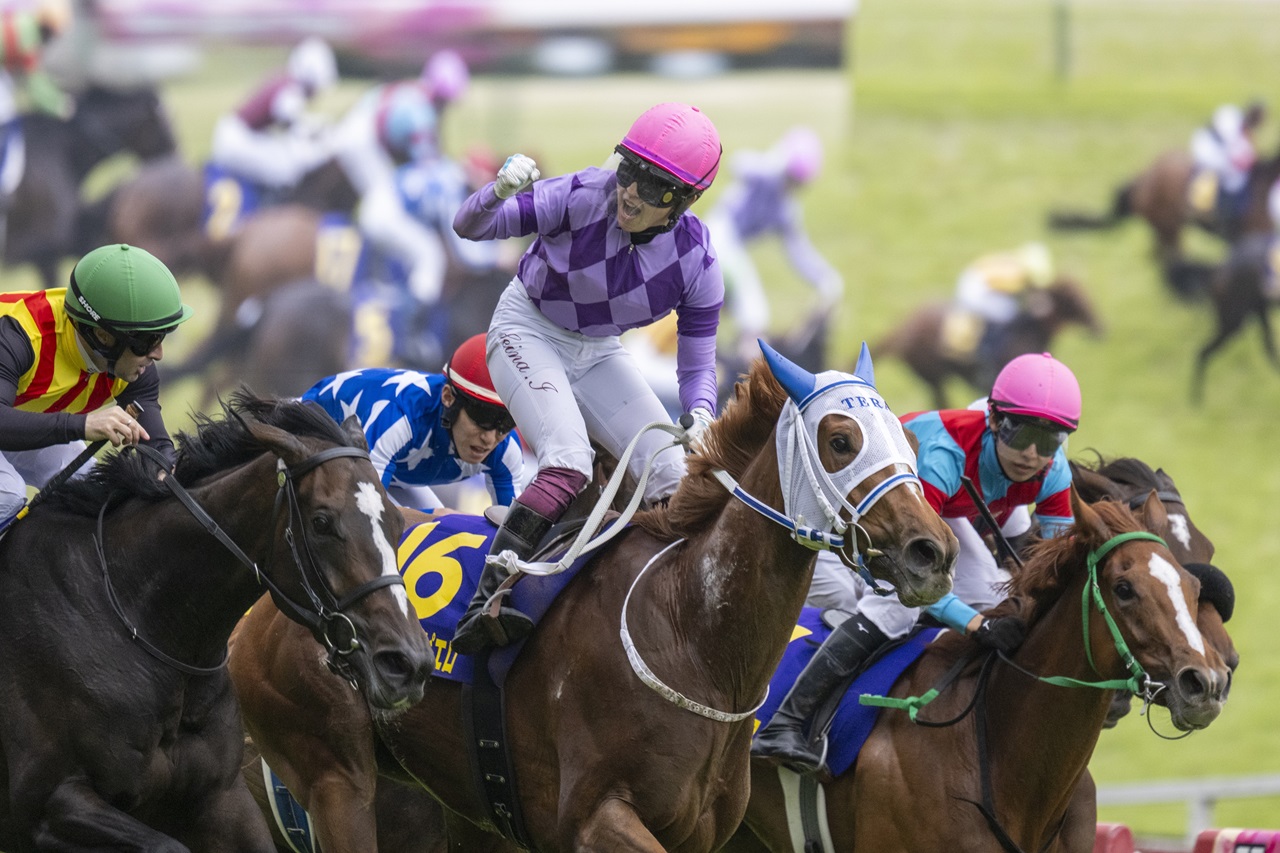
Juryoku Pierrot gets up to give Seina Imamura an historic win in the Japanese Oaks (Photo by Tomoya Moriuchi/Horsephotos.com)
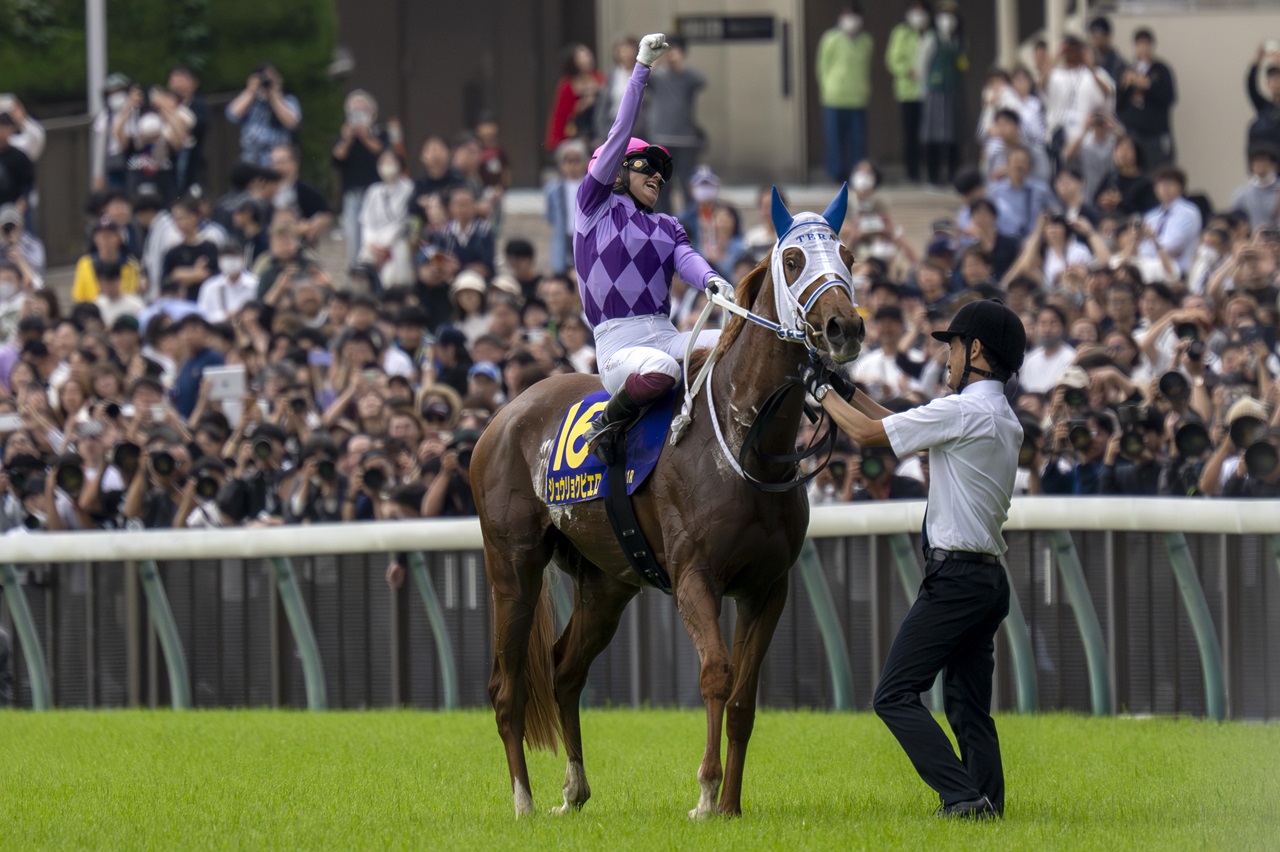
Seina Imamura celebrates her Japanese Oaks victory aboard Juryoku Pierrot (Photo by Tomoya Moriuchi/Horsephotos.com)
FOLLOW FOR UPDATES AND EXCLUSIVES
Missed something? Catch up on past Kentucky Derby news
Book Your Premium Experience
For Premium tickets, give us a call at 5026364447