Kentucky Derby Lucky Losers – Hansel (1991)
Apr 23, 2026
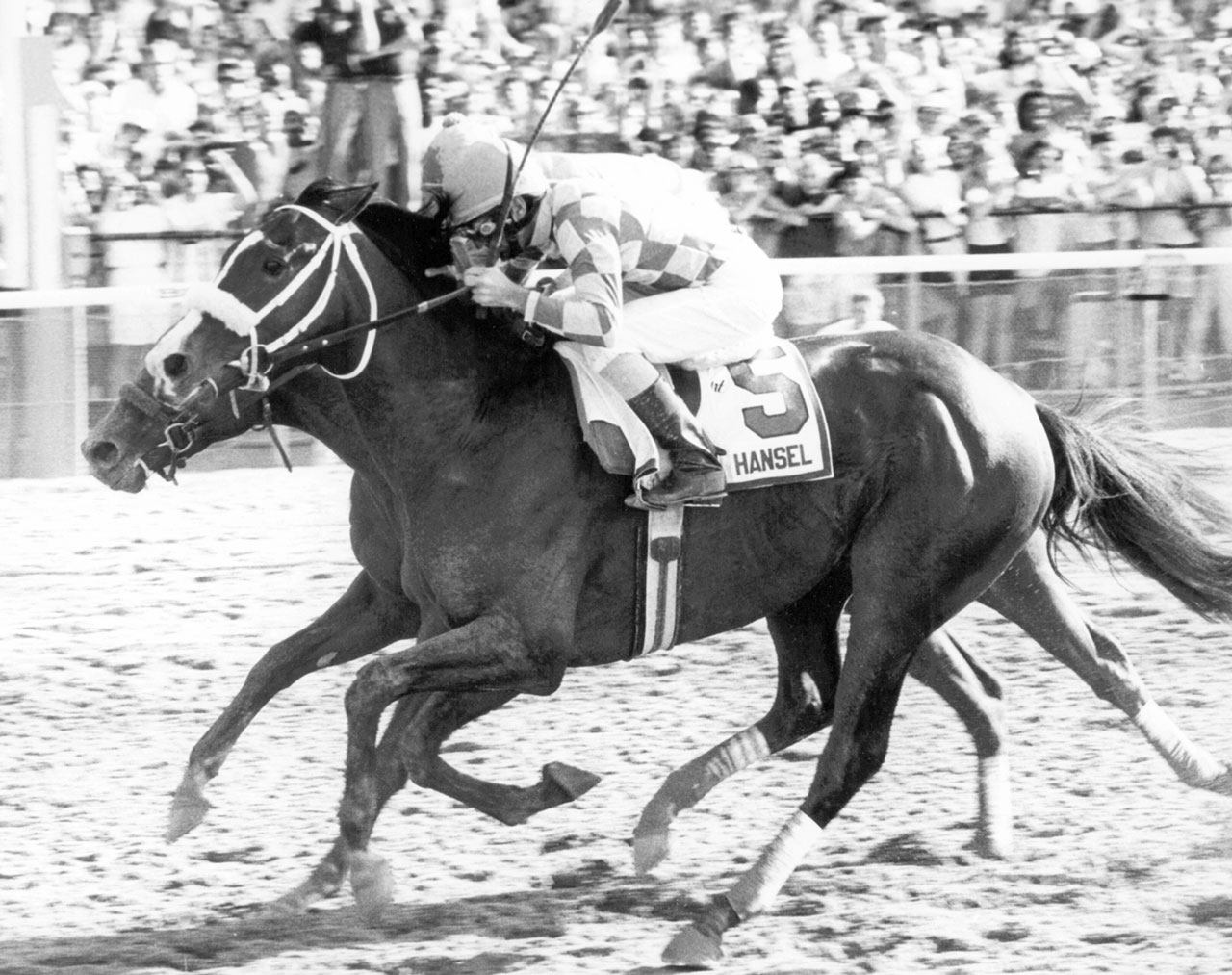
Hansel defeats Strike the Gold in the 1991 Belmont Stakes at Belmont Park. (Photo by Bob Coglianese)
“His momentum just stopped. I know it’s easy to say it, but I’ve got to believe he would have won. He wasn’t getting tired. He never took a deep breath,” said jockey Jerry Bailey in the moments after the 1991 Travers (G1).
Strides past the wire, Bailey had bailed from the saddle on Hansel after feeling something shift in the stretch drive that saw the colt finish just a neck back of Corporate Report. An equine ambulance collected the son of Woodman, and hours later, the news came down: an injury to a tendon in his left foreleg. That tendon would heal, but ultimately, it signaled the end to Hansel’s career on the racetrack and the beginning of his next career as a stallion at Gainsborough Farm in Kentucky.
Hansel exited the big stage before that autumn’s big tests and went to stud with a record of 14-7-2-3, his list of wins making him part of an elite group of horses in the history of the sport. First, though, Hansel took on the ten-furlong test at Churchill Downs and emerged short of a win under the Twin Spires. He then turned that lackluster showing into a dazzling sophomore season, only to be cut short by injury.
Getting Started
Though he was an American-bred horse, Woodman raced in Ireland for owner Robert Sangster, winning the Futurity and Anglesey Stakes at The Curragh in 1985. After his career was done, the song of Mr. Prospector stood at Ashford Stud in Kentucky and shuttled to Australia during his years at stud, producing horses like Hawk Wing and Hector Protector, stakes winners in Europe, and 1995 Preakness (G1) winner Timber Country. He also visited an unraced mare named Count On Bonnie, a granddaughter of Northern Dancer, and in March 1988, that bay mare delivered a dark bay colt with a white blaze and front and hind socks.
Bred in Virginia by Marvin Little, Jr., Count On Bonnie’s colt was consigned to the 1989 Keeneland September Yearling, where he was sold to Joe Albritton's Lazy Lane Farm for $150,000. Albritton named the colt Hansel, inspired by his sire Woodman, and sent him to trainer Frank Brothers for his preparations for the racetrack. Brothers, a former assistant to Jack Van Berg, sent his new charge to Arlington Park for his debut in June 1990.
He won on debut, a five-furlong maiden race, and then went straight into a stakes in his next start, the 5 ½-furlong Tremont S. at Belmont Park. There, he defeated a field that included Fly So Free, 1990’s eventual Champion Two-Year-Old Colt, by three lengths. He followed that up with a third in the Sapling S. at Monmouth and then a second in the Hopeful S. at Saratoga before returning to Arlington Park for the one-mile Arlington-Washington Futurity. Hansel scored the victory there after being boxed in traffic and then getting loose on the rail to nip Walesa by a neck at the wire. With a record of three wins in five starts as a two-year-old, a wrenched ankle meant that Brother had to give the son of Woodman a break in anticipation of his turn in 1991’s Triple Crown.
Hansel defeats Strike the Gold in the 1991 Belmont Stakes at Belmont Park. (Photo by Bob Coglianese)
Going the Distance
Fly So Free, whom Hansel defeated in the Tremont the previous July, entered 1991 as the Champion Two-Year-Old, winner of the Breeders’ Cup Juvenile (G1), and the early favorite for the 117th Kentucky Derby. Hansel met the champion once again in the Fountain of Youth (G2) at Gulfstream Park, and despite being away from the races since his win at Arlington months earlier, Hansel ran midpack while Fly So Free turned in a six-length romping victory. The Florida Derby (G1) was more of the same; though respiratory bleeding explained his lackluster performance in his previous race, Hansel, who was running on Lasix for the first time, could not manage better than third behind Strike the Gold and a triumphant Fly So Free.
Trainer Frank Brothers shifted tack to Turfway Park for the colt’s next start in the Jim Beam (G2). There, he set a track record of 1:46 3/5 for the nine furlongs in his 2 ½-length win. Still pointed to the Run for the Roses, Hansel went to the Lexington (G2) at Keeneland three weeks later and notched another victory. He made the short drive to Churchill Downs and entered the gate on Derby Day as the 2.5-1 favorite over Fly So Free at 3-1.
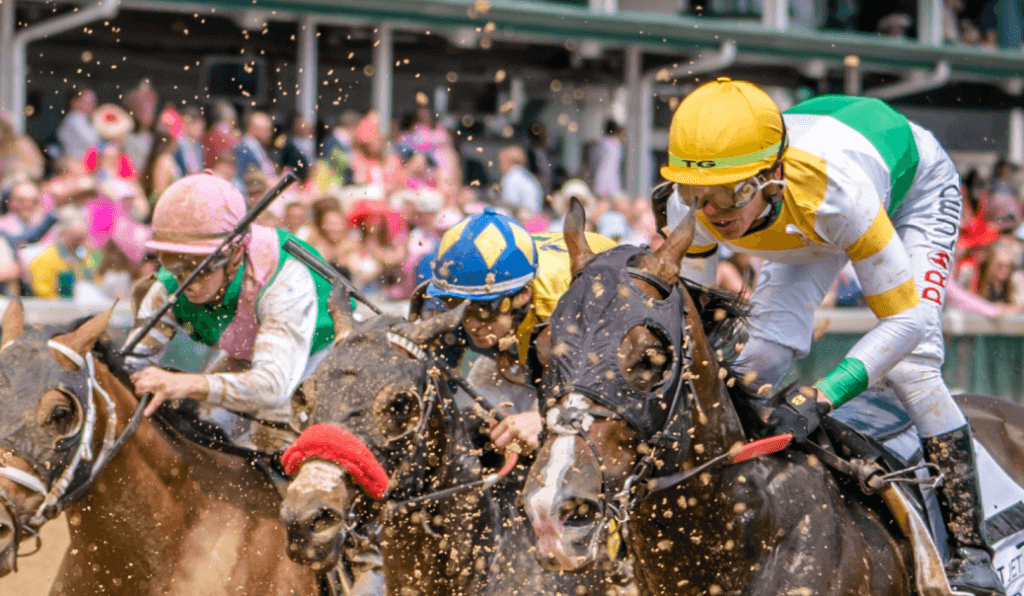
Hansel did not perform at his usual high level under the Twin Spires, finishing 10th behind Strike the Gold, whose late run helped him score a 1 3/4-length win. Brothers was unsure about whether or not they should move on to the Preakness (G1) two weeks later, but a three-furlong workout in :34 3/5 convinced both the trainer and owner Joe Albritton that the son of Woodman belonged at Pimlico. Their instincts were confirmed when Hansel shadowed Corporate Report and Olympio early and then took the lead in the stretch to win by seven lengths while Derby winner Strike the Gold finished back in sixth.
Three weeks later, Hansel and Strike the Gold once again faced off in the Belmont (G1), the 12-furlong Test for the Champion. Hansel started fast, hanging in third behind Another Review and Corporate Report, and then moved into the lead at the one-mile mark, four more furlongs to go. Strike the Gold was back in his customary late-running position, steadily moving through the field as he hit the stretch primed to make his bid. He drew even with Hansel in the late stretch, racing eye-to-eye with the Preakness winner on the rail and the Derby winner on his outside. A final push helped Hansel get a head in front at the wire, their finish the closest the race had seen since Affirmed sealed his Triple Crown in 1978. With wins in the Preakness and Belmont, Hansel had earned enough points in the Triple Crown Challenge to earn a $1 million bonus as well.
With four wins in seven starts halfway through his three-year-old season. Hansel was poised to finish the year as the top dog in his class. The Triple Crown season done, it was time for those valuable sophomore stakes in the second half of the racing year.
Finishing Strong
Seven weeks later, Hansel arrived at Monmouth Park with all of the momentum. Nearly a year after finishing third in the Sapling, he was back for the nine-furlong Haskell (G1). Facing a short field of only four others, the son of Woodman turned in a puzzling performance, finishing third, unable to produce a final kick that could have carried him past Lost Mountain and Corporate Report.
Three weeks later, Jerry Bailey was standing by as Hansel walked onto that equine ambulance after a tendon injury cut the colt’s career short. The jockey felt that the colt could have won the Travers if he had not suffered that injury in the stretch, another valuable sophomore prize for the Preakness and Belmont winner. Instead, Hansel recovered in his new life as a stallion. Still, Joe Albritton and Frank Brothers were able to collect the Eclipse for Champion Three-Year-Old Colt, Hansel earning his trophy thanks to his four wins in 1991.
Though the son of Woodman did not earn roses in his turn under the Twin Spires, Hansel was able to make hay of his three-year-old season with a sizzling victory at Pimlico and a squeaker of a win over Strike the Gold in the Belmont, another lucky loser who was able to parlay a defeat in one American classic to take the others and earn his spot in the history books.

FOLLOW FOR UPDATES AND EXCLUSIVES
Missed something? Catch up on past Kentucky Derby news
Book Your Premium Experience
For Premium tickets, give us a call at 5026364447