Kentucky Derby Lucky Losers – Ridan (1962)
Aug 19, 2026
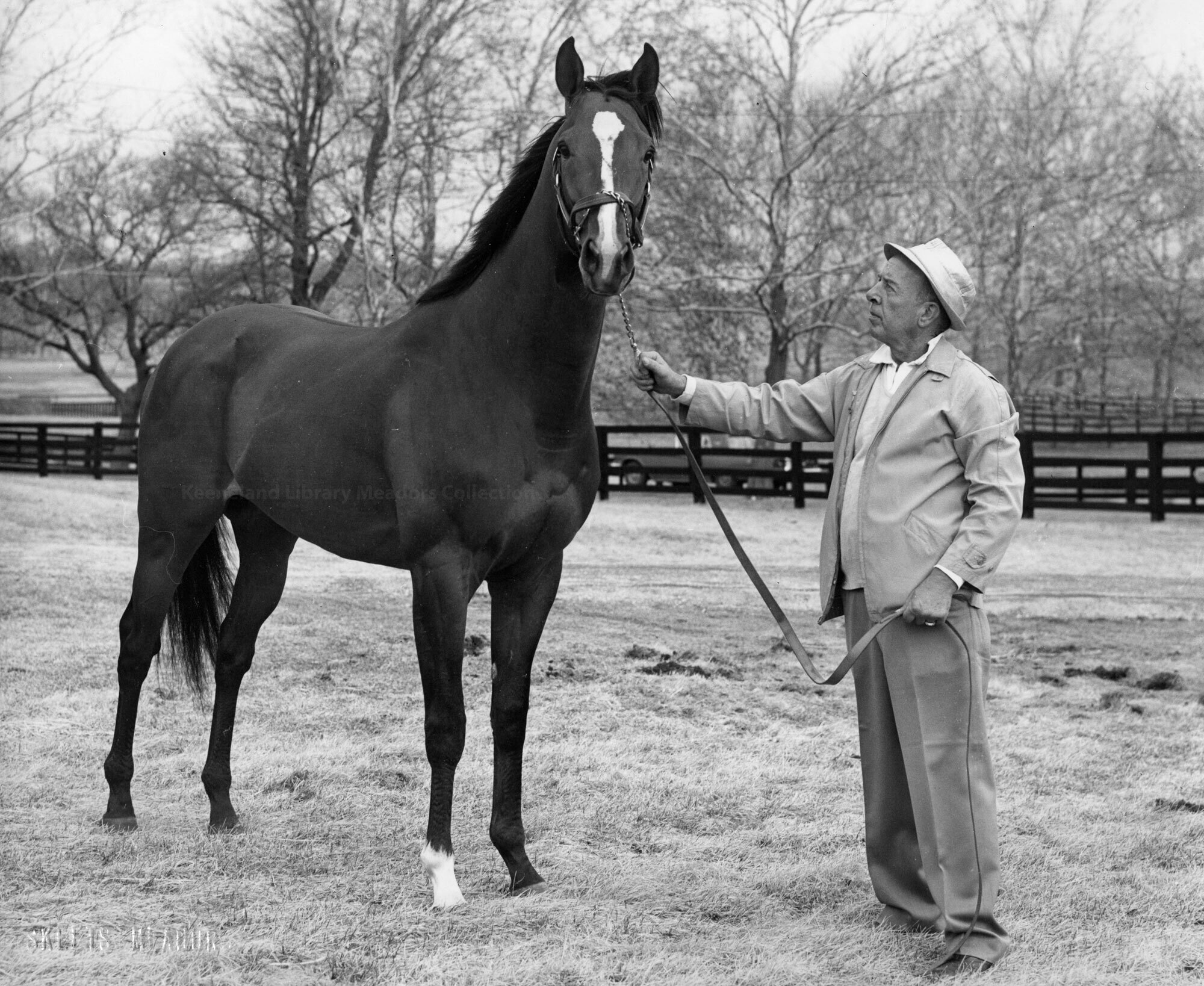
Ridan's arrival at Clairborne Farms in 1963 with Henry Gervais. (Photo courtesy of Keeneland Library / Credit to the Meadors Collection)
Undefeated at two, Ridan came into 1962’s Triple Crown season with high hopes for owners Dorothy Jolley, Ernest Woods, and John L. Greer. Though splint soreness kept him from meeting other juvenile starts of 1961, his springtime victories showed that the son of Nantallah deserved to be the favorite for the 1962 Kentucky Derby, but it would take a track record to beat him that day. A second record-breaking turn at Saratoga would also see Ridan on the losing end of a famed stakes.
Ridan's third-place finish under the Twin Spires in hindsight reads less like a defeat than a lucky break — the loss that cost him a shot at the Triple Crown but set up the two photo-finish classics, performances that would define him as one of the great near-misses in American racing.
Foundations
Nantallah was not an obvious choice for a Claiborne sire: even though his sire Nasrullah would produce a long list of winners, this colt wrestled with unsoundness, which kept him from racing beyond his sophomore season, eventually winning four of seven with no stakes wins. However, “Bull” Hancock saw potential there and brought him into their stallion barn to stand for $1,000. Breeder Thomas M. Girdler, former steel businessman, sent his mare Rough Shod II to Nantallah, and on Feb. 21, 1959, she foaled a bay colt with a stripe of white down his face and a right front sock.
Moody Jolley saw Rough Shod II’s yearling colt, who looked like another colt that he had trained, Nadir, and paid $11,000 for the young hopeful. He named the colt Ridan, or Nadir spelled backward, and listed his wife Dorothy as owner along with partners Ernest Woods and John L. Greer. His son LeRoy took on training the colt and sent him out for his debut on Feb. 10, 1961, a three-furlong maiden, which he won with ease. Ridan followed that with another victory in a four-furlong test over the Headley course at Keeneland.
After an allowance win at Washington Park in Chicago, Ridan moved on to stakes company and continued his streak with turns in the Hyde Park S., the Arlington Futurity, and the Prairie State S., before trying the Washington Park Futurity on Sept. 2. With Bill Hatrack in the saddle, Ridan faced the biggest challenge of his young career, starting farther back than usual and pressed to pass horses late to win by a length. He finished 1961 undefeated, soreness necessitating a break until the following January.
Triumphs
He opened the year with a win in the six-furlong Hibiscus S. at Hialeah, adding his eighth win, and then confronted Christopher Chenery’s Sir Gaylord in the Bahamas on Feb. 7, 1962. The seven-furlong stakes was the longest that Ridan had tried to that point, and the field, which included Sir Gaylord and Crimson Satan, the previous year’s Champion Two-Year-Old Colt, was among the toughest he had faced to that point. On the lead in the stretch, Ridan held on until Sir Gaylord passed him inside the final sixteenth and handed the son of Nantallah his first loss. He followed that with a third in the nine-furlong Everglades S., where Hartack moved the colt too early and then watched Sir Gaylord and Decidedly pass him. In the stretch, Ridan tired, swerved into a competitor, was disqualified, and placed fourth. Unhappy with Hartack’s performance, Jolley exchanged words with the jock and they parted ways.
Interference from Sunrise County in the stretch may have cost Ridan the win, but he at least earned second place after his competitor was disqualified. That set up the Florida Derby on March 31, where he met Sir Gaylord’s stablemate, the filly Cicada. She had finished the previous season as Champion Two-Year-Old Filly thanks to her long list of stakes wins in 1961. She took the lead six furlongs in while Ridan lay in wait in third. The pair hooked up in the stretch, battling to the wire as the colt managed to push a nose in front at the wire. He followed that up with a victory in the Blue Grass Stakes at Keeneland on April 26, nine days before the Kentucky Derby.
The field included Decidedly, the gray son of Determine, who won the 80th Derby in 1954, and Crimson Satan, whom Ridan had faced and beaten more than once in these early spring races. The Nantallah colt got away to a four-length win, traversing the nine furlongs in 1:47 3/5, just a fifth of a second off the track record, and then galloped out to cover 10 furlongs in 2:01, two-fifths of a second shy of Whirlaway’s Derby record from 1941. Clearly, it would take a record to beat Ridan on the first Saturday in May.
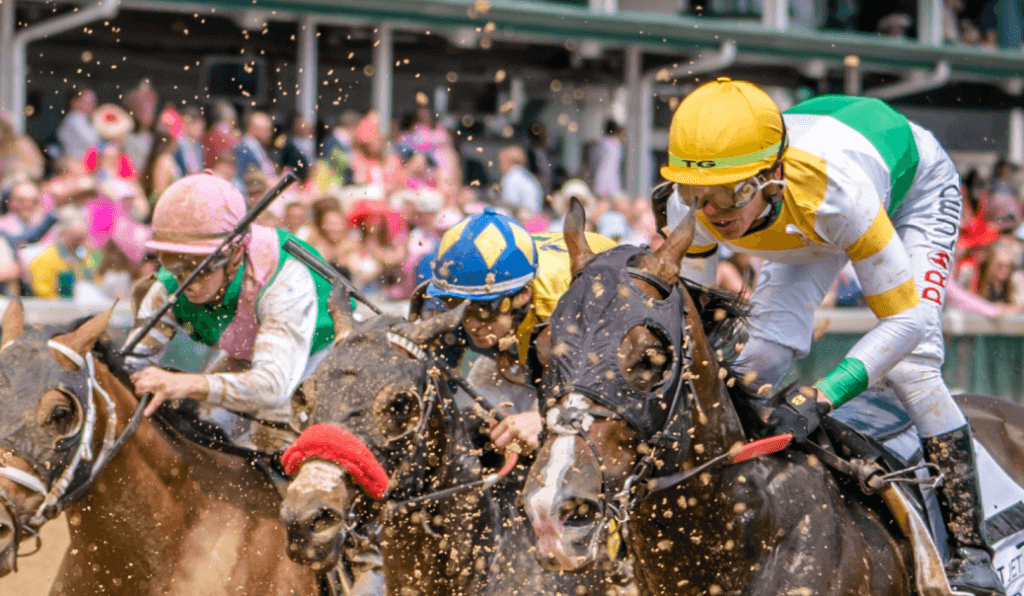
And that is exactly what Decidedly had to do to beat Ridan in the 88th Kentucky Derby. Behind the leaders early, Ridan and Manual Ycaza were part of a four-horse cavalry charge for the lead coming out of the stretch, but Hartack and Decidedly passed them inside the final eighth, winning the Derby by 2 1/4 lengths in 2:00 2/5, a track and race record. Ridan was again unsuccessful in the Preakness Stakes as he finished second to Greek Money after leading for part of the race. Jolley elected to skip the Belmont Stakes to focus on the second half of the season.
Cliffhangers
Ridan returned to competition in the one-mile Arlington Classic at Arlington Park in mid-July. He had no trouble adding that stakes over a muddy track, drawing off to win by seven lengths, but came up just short in the American Derby on Aug. 4. This set up a trip to Saratoga and a try at the 10-furlong Travers Stakes.
Ridan had already met Jaipur in the Preakness Stakes, where the latter finished 10th of 11, far behind his competitor. Owned by George Widener, chairman of the Jockey Club, Jaipur went on to win the Belmont Stakes by a nose over Admiral’s Voyage. He took a seven-week break and then returned in the Choice Stakes at Monmouth, where Bill Shoemaker rode him to victory. Then came a trip to Saratoga and a confrontation with Ridan.
Of course, they were not the only two in the field: Cicada was back in the mix alongside Cyane and Smart of the Christiana Stable and Military Plume and Flying Johnnie. But eyes were on stalls one and two of the starting gate, where Ridan and Jaipur broke in tandem. The pair battled throughout the ten furlongs, neither giving way, Ycaza on Ridan and Shoemaker on Jaipur taking care to keep their mounts straight and true throughout the race. Whenever one might take a short lead, the other would come back at their rival, the duo noses apart at the wire. Jaipur got the win in 2:01 3/5 and set a record in the process, lowering the stakes record set by Man o’ War 42 years earlier by a fifth of a second.
Ridan had two more starts in 1962, a third in the Aqueduct Handicap and a fifth in the Discovery Handicap, where he came back with a cut on his left hind leg. The following season, he added one more stakes, the Palm Beach Handicap, at four before an ankle injury ended his career. He retired to Claiborne Farm, his birthplace, where he stood until 1973. After a stint at Ballygoran in Ireland, Ridan later moved to Australia, where he died from an intestinal torsion in 1977.
Ridan's Derby defeat never defined him — if anything, it set the stage for the memorable performances that followed. His duels with Greek Money in the Preakness and then Jaipur in the Travers showed the grit and talent necessary to compete at the highest level. Ridan did not need a Derby win to leave his mark on the sport — he left it anyway, one hard-fought neck at a time.
FOLLOW FOR UPDATES AND EXCLUSIVES
Missed something? Catch up on past Kentucky Derby news
Book Your Premium Experience
For Premium tickets, give us a call at 5026364447