

Kentucky Derby Lucky Losers – Sword Dancer (1959)
Feb 24, 2026
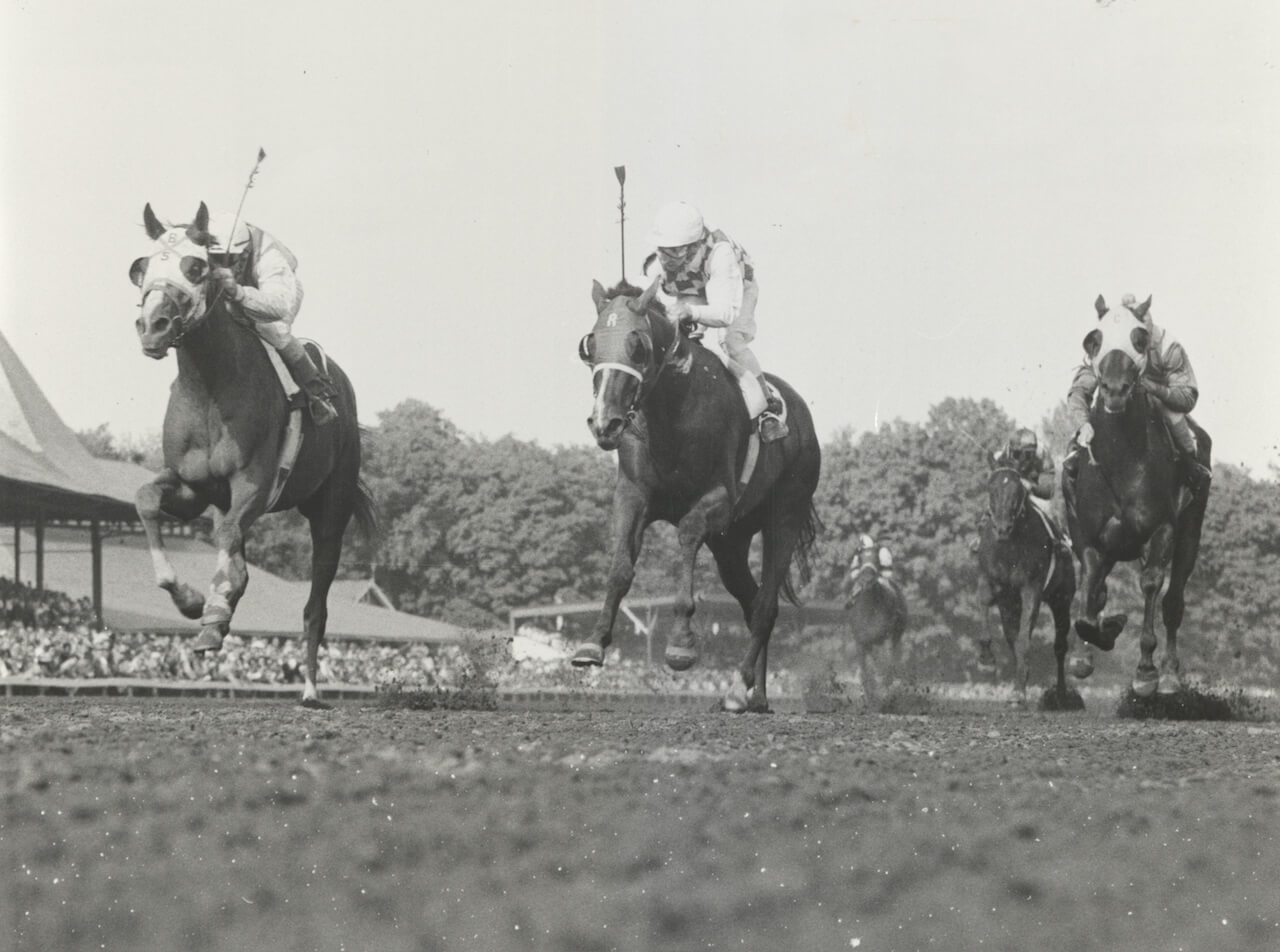
Sword Dancer, Manny Ycaza up, winning Travers Stakes over Middle Brother at Saratoga. (Photo courtesy of Keeneland Library / Credit to the Keeneland Library Morgan Collection)
How does a horse lose the Kentucky Derby by a nose, the Preakness by four lengths, and then still win Horse of the Year? By becoming a Lucky Loser, of course! In 1959, Brookmeade Stable’s Sword Dancer did just that, parlaying his close call in that Run for the Roses into a season that earned him not just Horse of the Year, but a spot in the Hall of Fame.
Sword Dancer’s close call under the Twin Spires touched off a year where he beat both the best of his division and older horses to earn his place among the sport’s best of all time.
Regal Roots
Named for her Long Island estate, Isabel Dodge Sloane’s Brookmeade Stable was no stranger to success by 1959. A socialite, heiress, and sportswoman, Sloane had been in racing since 1924, when she and her former husband started with steeplechasers. After her 1929 divorce, she continued racing on her own, winning the 1934 Kentucky Derby with Cavalcade and then that year’s Preakness with High Quest. The daughter of John F. Dodge, one of the founders of the Dodge Brothers Motor Company, Sloane used her fortune to invest not only in racing but also breeding, establishing Brookmeade Farm in Upperville, Va.
In 1948, she purchased the yearling Sunglow from Walter Salmon’s Mereworth Farm for $8,000 and then raced him in Brookmeade’s colors for 45 starts, with nine wins, including the Widener Handicap. His racing career done, Sloane sent Sunglow back to Mereworth to stand stud and sent her mare Highland Fling, an unraced daughter of Travers Stakes winner By Jimminy, to Sunglow in Kentucky. On April 24, 1956, Highland Fling foaled a flashy chestnut colt with three white socks and a wide slash of white across his face. Sloane would name him Sword Dancer.
His pedigree was stellar, even with his sire’s limited resume. Sunglow descended from Teddy, sire of Sir Gallahad III, one of the leading sires of the first half of the 20th century, alongside Gallant Fox, Hoop Jr., and a long list of other winners. Highland Fling’s granddam, Speed Boat, was a daughter of Man o’ War and a stakes winner herself, giving Sword Dancer quality on both top and bottom. That quality took a minute to emerge from the smallish colt.
Topping out at 15.3 hands, the Sunglow colt needed eight starts to break his maiden. Trainer Elliott Burch started him in a three-furlong maiden at Hialeah in late February and then kept trying until he broke through in a six-furlong maiden special weight at Saratoga in late August. He got his lone stakes victory at two in the one-mile, 70-yard Mayflower Stakes at Suffolk Downs, but his third behind First Landing, who would later sire Riva Ridge, and Tomy Lee, winner of the Del Mar Futurity, in the 1 1/16-mile Garden State Stakes gave a hint about what was to come. Sword Dancer finished his two-year-old season 14-3-2-3, with the best left to come for the son of Sunglow.
The Best Year
A fever early in 1959 kept Sword Dancer off the racetrack until March, when he was a tiring fifth in the Hutcheson S. at Gulfstream Park. He returned to the winner’s circle in an allowance race and then finished second to Easy Spur in the Florida Derby, renewing Burch’s confidence that Sword Dancer should remain headed to the Kentucky Derby. Beating Easy Spur in the Stepping Stone Purse five days before the Derby sealed the deal. However, he would be racing without Bill Shoemaker, who was already tapped to ride Tomy Lee in the big race. Burch instead got Bill Boland to ride Sword Dancer on the first Saturday in May.
Boland had been the pilot on Sword Dancer when the colt broke his maiden at Saratoga and already had one Derby win under his belt, taking the 1950 edition as an apprentice. Though First Landing, the previous year’s champion two-year-old colt, was part of the field, sixteen others came to Louisville to vie for the Run for the Roses, including Tomy Lee, Easy Spur, and Sword Dancer. The Brookmeade colt broke from post 13, with First Landing close to the rail in post 3 and Tomy Lee in between in post 9.
Troilus led for the first six furlongs, with Tomy Lee a couple of lengths back waiting for his chance to make a move. Boland had Sword Dancer back in fourth, and when he saw Shoemaker move Tomy Lee to the lead, the Sunglow colt went with him. For a beat, Tomy Lee had a head in front, but Sword Dancer passed him as they rounded into the stretch, gaining an advantage on the outside of Tomy Lee on the rail. The pair dueled down the stretch, Sword Dancer eking out a brief lead, but Tomy Lee got the better of him right when it counted, a nose in front at the wire. Boland lodged a foul against Shoemaker for interference, but the Churchill Downs stewards denied his claim and allowed the results to stand.
Two weeks later at Pimlico, with Shoemaker in the saddle, Sword Dancer was again second, this time by four lengths, to Royal Orbit in the Preakness. With four weeks between the Preakness and the Belmont, Burch put his colt in the one-mile Metropolitan Handicap, where he started a hot streak that would last through the second half of 1959. He beat a field of older horses in near-track record time, his 1:35 1/5 just two-fifths of a second off the record.
Back at Belmont Park for the 12-furlong Belmont Stakes, Sword Dancer navigated a sloppy track and powered to the lead in the long stretch to win by three-quarters of a length, his victory giving Sloane and Brookmeade their last classic victory. That winning streak moved to the Monmouth Handicap next, then a second against older horses in the Brooklyn Handicap, and landed at Saratoga and the Travers Stakes. There, he took control of the three-year-old division with his win in the Midsummer Derby.
To round out his sophomore season, Burch pitted Sword Dancer against older horses in the Woodward, which he won by a head while setting a track record for the mile and a quarter, and then the two-mile Jockey Club Gold Cup, a seven-length victory over the veteran Round Table. At year’s end, the Brookmeade colt received three awards for his stellar second half, including co-champion handicap male, champion three-year-old colt, and Horse of the Year.
The son of Sunglow got a much-needed break ahead of his four-year-old season and more chances to bring home some of the sport’s great prizes.
Final Act
The new year was not as kind to Sword Dancer as 1959 had been, but he was able to score a second Woodward Stakes as well as wins in the Suburban and Grey Lag Handicaps. He injured an ankle training for the Washington D.C. International on the turf and retired with a record of 39-15-7-4 and $829,610 in winnings. Sloane opted to stand her champion in at Darby Dan Farm in Kentucky rather than at her Virginia farm.
He was a fair sire, finishing third on the general sire list in 1967 thanks to Damascus, whose three-year-old season that year mirrored Sword Dancer’s own. Countess Bathanny leased the stallion to stand alongside Dark Star, the 1953 Kentucky Derby winner, at Haras du Bois Roussel in France. He died there in 1984, seven years after his induction into the Hall of Fame.
Despite his narrow defeat in the 1959 Kentucky Derby, Sword Dancer proved that one loss does not define a horse’s enduring legacy. He transitioned from a lucky loser at Churchill Downs to a dominant force, earning him a much-deserved spot in the sport’s history and passing on his grit and gumption to the generations that came after his time on the track and at stud.
FOLLOW FOR UPDATES AND EXCLUSIVES
Missed something? Catch up on past Kentucky Derby news
Book Your Premium Experience
For Premium tickets, give us a call at 5026364447
Calling All Derby Enthusiasts to Post
The Road to the 152nd Kentucky Derby is underway! Submit your email and receive newsletters for all things Kentucky Derby directly to your inbox.
This Is Your Moment
The fashion. The roar. The roses. Only select ticket options remain for Kentucky Derby 152. Be part of the story. Buy today or connect with our sales team for premium options and personalized service.
Get in Touch with the Kentucky Derby Team
Contact us via email or phone
Email: sales@kyderby.com | Phone: (502) 636-4447
All 2-day ticket packages are currently available for purchase. By filling out this form, a member of our team will reach out to help you decide which section is best for you and help you complete your purchase