Kentucky Oaks legacies: 1930 winner Alcibiades
Oct 02, 2026
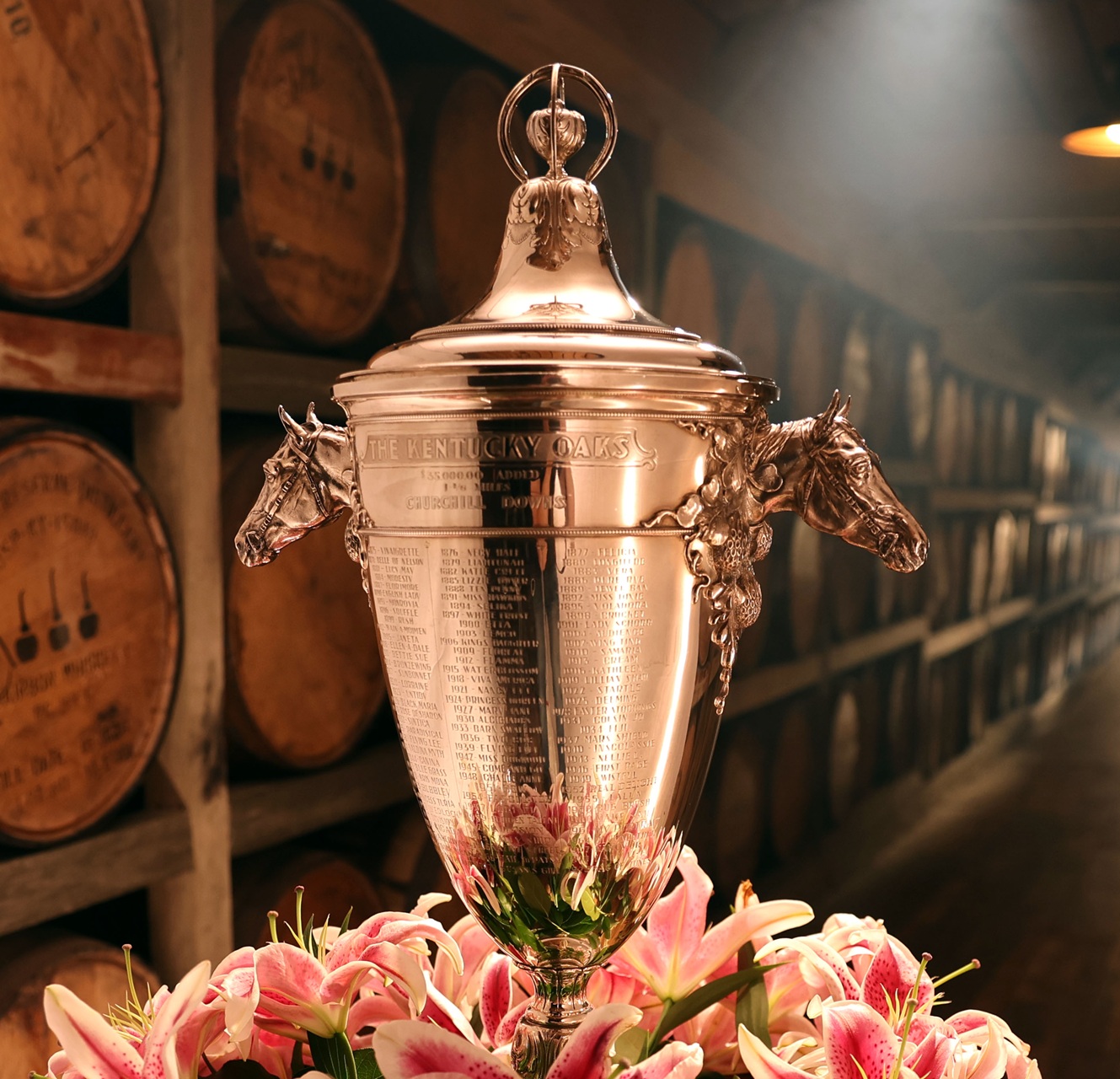
Kentucky Oaks trophy (Photo by Coady Media)
Champion filly Alcibiades, the 1930 Kentucky Oaks winner and Derby competitor, is commemorated with a Grade 1 race in her honor on the opening Friday of Keeneland’s fall meet. Fittingly, the Alcibiades (G1) is a scoring race on the Road to the Kentucky Oaks, and a “Win and You’re In” for the Breeders’ Cup Juvenile Fillies (G1).
Alcibiades raced before Keeneland was even established, but she has a direct connection to the track in the heart of the Bluegrass. Her owner/breeder, Hal Price Headley, played a pivotal role in founding Keeneland, and he served as the track’s president for its first 15 years of operation (1936-51).
The National Museum of Racing Hall of Fame posthumously honored Headley as a Pillar of the Turf. His daughter, Alice Chandler, was influential in her own right through her development of Mill Ridge Farm and would also be enshrined as a Pillar of the Turf.
Hal Price Headley was one of 12 people inducted today into the Racing Hall of Fame as Pillars of the Turf. Click through to read the story and watch a video for a better look at the phenomenal man that was Hal Price Headley and his impact on the sport → https://t.co/3kkOfIi866 pic.twitter.com/bhafZ9YY1U
— Keeneland (@keeneland) August 3, 2018
Alice was the inspiration behind Alcibiades’ name. In her childhood, Alice picked up the nickname Alcibiades, and Headley decided to use it for one of his homebred fillies.
Racing fans could well have imagined that ancient history played a role in her name. By Supremus, from the sire line of the brilliant Domino, she was out of the imported *Regal Roman, a daughter of Roi Herode and Lady Cicero. In that context, it wouldn’t be too great a leap to think of the ancient Athenian political figure Alcibiades, but the intentional Greek names didn’t begin until the filly started producing her own foals.
The equine Alcibiades built a glowing legacy worthy of Alice, so it’s just as well that she wasn’t named for the notorious Athenian. A champion at both two and three on the racetrack, she developed into a broodmare of epic proportions.
Alcibiades won four of seven starts as a juvenile in 1929, including the Debutante S. at Churchill Downs and the Clipsetta S. at Latonia (now known as Turfway Park). She didn’t have the best of luck when taking on the boys in a couple of major races that now belong to the Road to the Kentucky Derby.
In the Breeders’ Futurity, then staged at the old Lexington Association track, Alcibiades was hampered early and unable to deploy her blazing speed. She was favored in the Kentucky Jockey Club back at Churchill, where Desert Light denied her by just a head.
And where FOUNDATIONS are built ALCIBIADES-1930 Kentucky Oaks winner..
and CHAMPION for Hal Price Headley pic.twitter.com/stdbLXLnTY
— Headley Bell (@headleybell) September 4, 2020
Alcibiades tried the 1930 Kentucky Derby, in those days contested before the Oaks. Although she dashed clear early, she could not sustain her speed. Triple Crown winner Gallant Fox overtook her by the halfway mark, and Alcibiades faded to 10th.
Back among fillies two weeks later in the Kentucky Oaks, Alcibiades lasted the 1 1/8-mile distance to prevail by a length. Her only other stakes win that season came in the Arlington Oaks, but she placed in four notable events. Alcibiades finished third in the Latonia Oaks, Illinois Oaks, Arlington Matron, and the Hawthorne Gold Cup against older males, won by Hall of Famer and one-time earnings record-holder Sun Beau.
Alcibiades became more memorable through her progeny and their descendants, making her a factor in modern pedigrees worldwide.
Her best son, Menow, ranked as the champion two-year-old colt of 1937 after front-running romps in the 1937 Champagne and Futurity. He won the latter in 1:15 1/5 for 6 1/2 furlongs, then a world-record time.
MENOW 🇺🇸1935 (PHARAMOND II- ALCIBIADES by SUPREMUS)#Menow Stakes winner 🏆 in USA. World record set at 2yo at Belmont. 1937 champion 2yo Colt. Leading sire Sired 32 sw. Stood at Beaumont farm. Buried at @millridgefarm pic.twitter.com/F7HfCxrUt3
— HORSE RACING 100 (@HORSERACING1002) August 27, 2022
Menow had stamina limitations that became apparent at three. Caught by future supersire Bull Lea in the 1938 Blue Grass, Menow set the pace before tiring to fourth in the Kentucky Derby and third in the Preakness. He rebounded on the cutback to a mile in the Withers.
But Menow was able to carry his speed to upset the 1937 Triple Crown star, War Admiral, in the 1 1/8-mile Massachusetts H. The heavy track at Suffolk Downs catered to his running style, especially under a feathery 107 pounds, and he went wire to wire by eight lengths. Menow later beat his old rival Bull Lea in the Potomac H. and concluded his career with a third to the legendary Seabiscuit in the Havre de Grace H., where he was injured.
Menow sired Hall of Famer Tom Fool, whose all-time great son Buckpasser became an indelible influence himself. Menow’s bloodlines also live on through his daughters, who produced the likes of Canadian Hall of Famer Flaming Page (mother of English Triple Crown sweeper and outstanding sire Nijinsky); champions High Voltage and Castle Forbes, both noted matrons; and Red God (sire of star European miler and international sire Blushing Groom).
#TreasureOfTheVaultTuesday Today’s post is a 1954 painting of Tom Fool by Richard Stone Reeves. Tom Fool (b. 1949, by Menow out of Gaga, by Bull Dog) earned Horse of the Year honors in 1953 after winning all 10 of his races at 4, including the Whitney Stakes at Saratoga. pic.twitter.com/FZM2L0TCqr
— National Museum of Racing and Hall of Fame (@nmrhof) August 11, 2020
Alcibiades had a trio of major stakes-winning daughters who helped propagate the line.
Salaminia, her filly by the immortal Man o’ War, defeated older males as a three-year-old in the 1940 Gallant Fox H. Her sophomore campaign also featured wins in the Alabama S. and Ladies H.
Salaminia’s best daughter, multiple-stakes victress Athenia, was runner-up in the 1946 Kentucky Oaks. But Athenia’s most valuable contribution was her grandson, Sir Ivor.
Bred by Alice Headley, Sir Ivor became a champion in both Ireland and England. His trademark acceleration propelled him to victories in the first two British classics of 1968, the 2000 Guineas at Newmarket and the Derby at Epsom, as well as the Champion S. and the Washington D.C. International in his lone stateside appearance.
Somehow Epsom looks so different, but so familiar! 🎥
Relive the 1968 Derby, won by SIR IVOR and Lester Piggott 🏆#CazooDerby pic.twitter.com/gtzFXYJQ8k
— Epsom Downs Racecourse (@EpsomRacecourse) June 2, 2022
Sir Ivor’s genes went global through his son *Sir Tristram, a history-making sire from his outpost in New Zealand, and an army of daughters. Sir Ivor mares forged key links in the global chain of pedigrees by foaling the likes of Green Desert, El Prado, Alzao, Bluebird, and Shareef Dancer, not to mention those lurking deeper in productive families.
Another multiple stakes winner out of Alcibiades, Sparta became the direct female-line ancestress of $3 million-earner Free House, who placed in all three jewels of the 1997 Triple Crown, and Cloud Computing, the 2017 Preakness (G1) winner.
Alcibiades’ top earner, Lithe, won or placed in 18 stakes in a 62-race career. She scored her first big victory in the 1948 Demoiselle, but she kept adding to her resume through the age of five. Perhaps her most eye-catching placing was a third to Hall of Fame males Coaltown and Armed in the 1949 Washington Park H.
Lithe was Menow’s baby sister, and another full sibling, Hipparete, had greater success as a broodmare than on the racetrack. Hipparete produced Rash Statement, whose major wins included the 1959 Alcibiades in honor of her great-grandmother, and 1957 Black-Eyed Susan heroine Pillow Talk, who was also runner-up in the Kentucky Oaks.
Pillow Talk’s matrilineal descendant Silent Account, the 1985 Alcibiades winner, became the grandmother of millionaire Plum Pretty, who captured the 2011 Kentucky Oaks.
Plum Pretty illustrates Alcibiades far-reaching influence. Alcibiades appears not only in her direct maternal line, but she also factors in the ancestry of Plum Pretty’s sire, Medaglia d’Oro (via El Prado), as well as her maternal grandfather, A.P. Indy, and her grandmother’s sire, Private Account (both via Buckpasser).
El Prado’s mother, Irish classic winner Lady Capulet, was a Sir Ivor filly out of a Tom Fool mare. Hence she had two crosses of Alcibiades.
That same pattern of Sir Ivor over a Tom Fool mare yielded Sweet Alliance, who figures in the pedigree of the late, great Dubai Millennium. Bequeathing the sensational stallion Dubawi in his only crop of foals, Dubai Millennium sported a duplication of Tom Fool.
If her namesake, Alice, became a Pillar of the Turf, you might say that Alcibiades became a pillar of pedigrees.
FOLLOW FOR UPDATES AND EXCLUSIVES
Missed something? Catch up on past Kentucky Derby news
Book Your Premium Experience
For Premium tickets, give us a call at 5026364447