Kentucky Derby Lucky Loser – Snow Chief (1986)
Jun 29, 2026
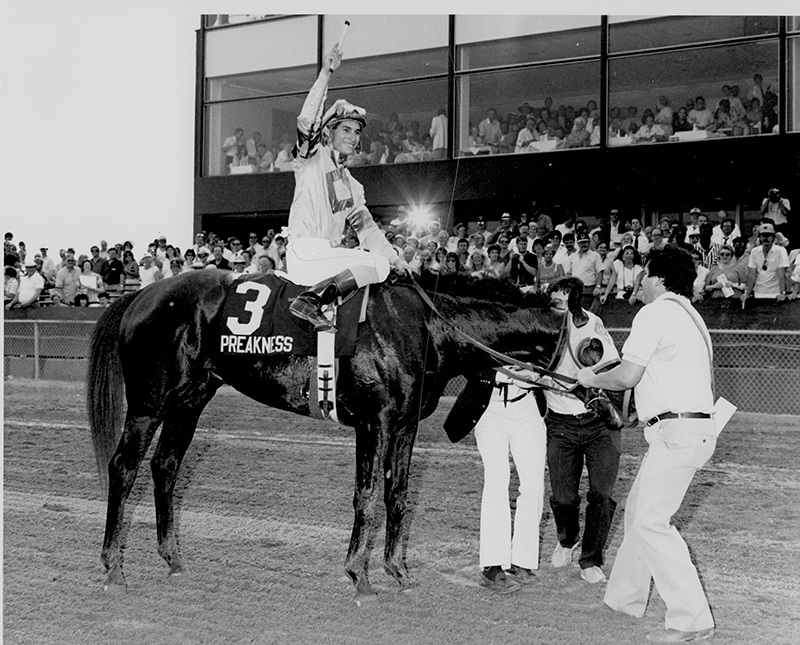
Jockey Alex Solis celebrates after Snow Chief's victory in the 1986 Preakness (G1) (Photo by Jim McCue/Maryland Jockey Club)
What makes a horse a Kentucky Derby Lucky Loser? The first is the record that earned the horse in question a spot in the Kentucky Derby, usually involving a series of stakes wins that grab the sport’s attention. That record implies success under the Twin Spires, but something—or someone—gets in the way and suddenly this horse is walking back to the barn without a blanket of roses in tow. The championship career that follows shows how the Lucky Loser turned a defeat into a career of note.
This particular Lucky Loser had humble beginnings but showed that the sport's best can come from anywhere at any time.
Humble Beginnings
What do Anderson’s Pea Soup Restaurant, Hall of Fame trainer Hirsch Jacobs, and the Preakness Stakes have in common?
A black California-bred colt named Snow Chief.
His sire Reflected Glory showed promise early in 1967, winning the Bahamas Stakes and Everglades Stakes at Hialeah for Hirsch Jacobs, but sore shins kept him from shining brighter in a crop that included Damascus and Buckpasser. Upon retirement, he stood briefly in Kentucky before California veterinarian Dr. James Buell purchased the stallion for his Rancho Jonata near Buellton, home of the landmark Anderson’s Pea Soup Restaurant. There, in 1982, the stallion covered a maiden mare named Miss Snowflake.
Owned by Carl Grinstead, a retired electrical engineer, the daughter of Snow Sporting raced at Caliente Hipódromo, formerly Agua Caliente, in Tijuana, winning one race before he retired her to broodmare life. On March 17, 1983, Miss Snowflake foaled a dark bay colt with a diamond of white on his forehead. Grinstead would name him Snow Chief.
When the colt was a yearling, Grinstead gained a partner in his Blue Diamond Ranch, as former vaudeville performer turned real estate investor Ben Rochelle wanted to buy into one of his horses, Sari’s Dreamer, but to do that, Rochelle had to buy into Grinstead’s whole stable. That included Snow Chief, a fortuitous purchase for the former dancer as Sari’s Dreamer’s biggest win was the Grade 2 Mervyn Leroy Handicap while Miss Snowflake’s nearly black colt was set to take his owners on a far bigger ride.
California Dreaming
Sent to the partnership’s trainer Mel Stute, Snow Chief debuted with a win in a five-furlong maiden for California-breds at Hollywood Park in June 1985. After a sixth-place finish in the Desert Wine Stakes, the colt was sidelined with an injury until early September, when he returned to win the Rancho Santa Fe Stakes. He followed that up with a third in the Del Mar Futurity, then a second in the Sunny Slope before taking his first Grade 1 in the Norfolk Stakes at Santa Anita. That three-length win gave Stute his first Grade 1 stakes win, and Snow Chief followed up with a second in the December Hollywood Futurity.
Regular rider Alex Solis had suggested blinkers to the trainer earlier in the autumn as the colt was still running green despite his regular top-3 finishes. Reluctant to change anything because his charge was performing well, the addition of the hood focused Snow Chief in a way that he had not seen previously. He powered away to a 6 1/2-length win over a field that included another promising two-year-old named Ferdinand. With five wins in nine starts at two, Snow Chief went into 1986 as one of the horses to watch for that year’s Triple Crown. The lead-up to the Kentucky Derby showed why.
He started with a win in the California Breeders’ Championship Stakes at Santa Anita a month after the Hollywood Futurity. That four-length win made him the youngest millionaire to that point, and he then followed up with a trip to Bay Meadows and a win in the El Camino Real Derby that squarely put him on the Derby trail. From there, he went from the Pacific coast to the Atlantic to try the Florida Derby at Gulfstream Park. Snow Chief took the lead from the break and held off the full field of 15 others at bay by 1 3/4 lengths. He winged back to California for one more prep for a trip to Louisville, the Santa Anita Derby.
He faced six others, including Ferdinand, in the nine-furlong test and passed with flying colors, exiting the six-length win as the solid favorite for the 112th Kentucky Derby. In the 1986 Run for the Roses, the field of 16 included Groovy, Broad Brush, and Ferdinand, with the latter coming out on top; Snow Chief was 11th. “When they turned for home, he just came up empty,” Stute told reporters. “Alex said he asked him, but he didn’t respond. He would always respond in his other races.”
Seeking redemption for his beaten favorite, Stute sent Snow Chief to Baltimore for the Preakness Stakes, where he would face the Derby winner, Groovy, and Broad Brush again. This time, though, Solis followed the trainer’s advice and stuck close to the rail throughout, shadowing Groovy through solid early fractions and then took the lead in the stretch to win by four lengths.
His Baltimore victory ended Snow Chief's Triple Crown bid. Stute chased the rich purse of the Jersey Derby at Garden State, where a slight ankle injury kept him from trying the Belmont Stakes. The son of Reflected Glory finished third in the Silver Screen Handicap in his next start as a knee injury sidelined him until late December.
Sustained Brilliance
Ferdinand and Snow Chief renewed their rivalry in the Malibu at Santa Anita as their three-year-old seasons wound down. The pair eventually would meet nine times over their careers, with Snow Chief coming out on top in a half-dozen of those meetings. Not this time, though: Ferdinand passed his rival late in the seven-furlong stakes to win by 1 1/4 lengths. Despite losing the Derby to Ferdinand, Snow Chief’s stellar 1986 season was enough to earn him the Eclipse for Champion Three-Year-Old Colt.
The pair met again three weeks later, with the pair of newly turned four-year-olds finishing third and fourth behind longshot Variety Road and Broad Brush in the Grade 1 San Fernando. Snow Chief went to the lead right out of the gate in the Charles H. Strub and managed to hang on to win by a nose as Ferdinand poured on the speed late, the pair making contact throughout the stretch run.
In the Santa Anita Handicap, Ferdinand’s stablemate Epidaurus lured Snow Chief into an early speed duel, and then Broad Brush and Ferdinand dueled in the stretch. Broad Brush emerged the winner by a nose, with the Preakness winner back in fifth.
In late March, Stute sent Snow Chief back east for the Gulfstream Handicap, where he finished third. A few days later, the owner, Carl Grinstead, passed away, leaving Ben Rochelle to carry on. The trainer sent their horse to Oaklawn Park for the Grade 2 Oaklawn Handicap, which Snow Chief won in track record time. That would be his last victory. A tendon injury in his next start, the Grade 1 Californian, ended Snow Chief’s career. The California-bred retired to Mira Loma Thoroughbred Farm and then stood at a series of other farms in the Golden State before his death in 2010.
Though Snow Chief's eleventh-place finish beneath the Twin Spires in 1986 stands as one of the more surprising losing performances in Kentucky Derby history, it ultimately proved to be little more than a brief stumble for a horse of his caliber. With a Preakness victory, three California Horse of the Year titles, and earnings of over $3.3 million, Snow Chief's legacy endures as proof that a single bad afternoon in Louisville could never define a true champion.
Read about more Lucky Losers here:
Kentucky Derby Lucky Losers – Damascus (1967)
Kentucky Derby Lucky Losers – Hansel (1991)
Kentucky Derby Lucky Losers: Sun Beau (1928)
Kentucky Derby’s Lucky Losers: Bull Lea (1938)
Kentucky Derby Lucky Loser – Roman Brother (1964)
Kentucky Derby Lucky Losers – Sword Dancer (1959)
Kentucky Derby Lucky Losers: Market Wise (1941)
Kentucky Derby’s Lucky Losers: Groovy (1986)
Kentucky Derby Lucky Losers: Bold Ruler (1957)
Kentucky Derby’s Lucky Losers: Devil Diver (1942)
Kentucky Derby Lucky Losers: Gulch (1987)
Kentucky Derby Lucky Losers: Cleopatra (1920)
Kentucky Derby’s Lucky Losers: Skywalker (1985)
Kentucky Derby Lucky Losers: Granville (1936)
Kentucky Derby Lucky Losers: Forego (1973)
Kentucky Derby Lucky Losers: Cryptoclearance (1987)
FOLLOW FOR UPDATES AND EXCLUSIVES
Missed something? Catch up on past Kentucky Derby news
Book Your Premium Experience
For Premium tickets, give us a call at 5026364447